

The power source is the second-most-important decision when buying Christmas lights - right after the light type itself. It decides where the light can go, how long it runs, and what it costs over the season. This guide compares the four real options: plug-in, battery, USB, and solar.
The Four Power Sources at a Glance
| Source | Typical runtime | Best for | Cost over a season |
|---|---|---|---|
| Plug-in | All day, unlimited | Eaves, garlands, storefronts | Low (mains draw is small) |
| Battery | 8-12 hours per charge | Tables, mantels, no-outlet spots | Medium (alkaline) or low (rechargeable) |
| USB | All day, unlimited | Desks, small indoor displays | Low (mains draw is small) |
| Solar | 6-8 hours per night | Garden, patio, fence | Zero (after purchase) |
Plug-in: The Default for Permanent Installs
Plug-in is the right choice whenever the light will stay in one place for the whole season. Eaves, garlands, storefronts, long window treatments - if it's going to be on more than a few hours a day, plug-in is the answer.
Three features to look for on a plug-in set:
- Timer - so the light turns off at a set hour and you're not leaving it on all night.
- Mode memory - so the light returns to your chosen mode after a power cut, instead of resetting to mode 1.
- Lead wire length - 3-5 m is standard, so you can run the cord back to a sheltered outlet without an extension lead.
Our 300 LED icicle string lights with timer and the 300 LED icicle lights are good examples of plug-in sets built for eaves and garlands.
Battery: Where a Plug Is Out of Reach
Battery is the answer for tables, mantels, window sills, and any outdoor spot where running a cord is impractical (a garden party, a balcony, a porch without an outlet).
Two things matter more than any other spec:
- Runtime per charge - a 2-AA or 3-AA set runs 8-12 hours, depending on bulb count and mode. For an all-night display, 3-AA or a rechargeable pack is the safer choice.
- Alkaline vs rechargeable - alkaline is cheaper per pack but adds up fast over a season. Rechargeable packs cost more upfront and less per use. If you're running the lights nightly for 6+ weeks, rechargeable wins on total cost.
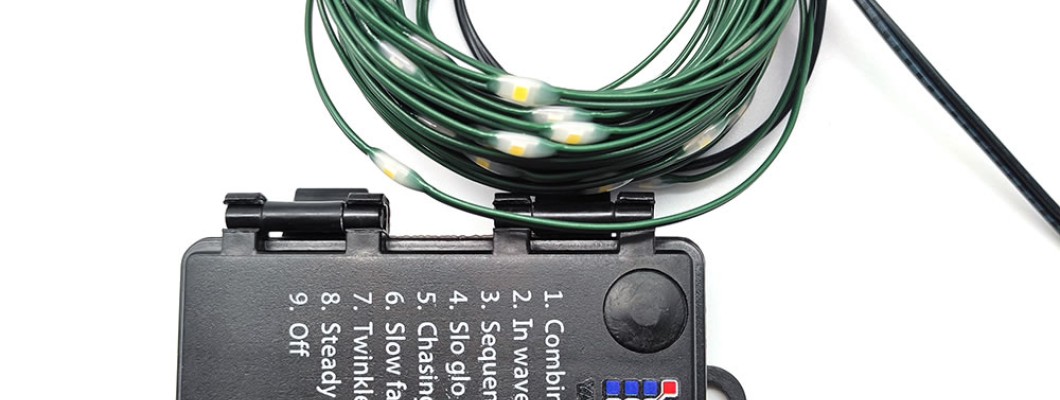
Good battery-operated options: our 50 LED battery-operated string lights for a compact indoor pick, and the battery-powered bunch lights for a tree-canopy look.
USB: The Low-Draw Indoor Option
USB sits between battery and plug-in. It draws from a laptop, power bank, or USB hub, so it's "unlimited" runtime (as long as the source is on) but the draw is small enough to run from a power bank for a full night.
Best for:
- Office desks and small indoor displays
- Photo backdrops and trade-stand displays
- Anywhere a mains socket is inconvenient but a power bank is not
Our USB copper wire fairy lights and the USB 100 LED string with timer and dimmable remote are good examples. Note: USB sets are almost always indoor-rated (IP20) - for outdoor use, go solar or plug-in instead.
Solar: The Zero-Cost Outdoor Option
Solar is the best choice for the garden, patio, and fence - anywhere you can't run a cord and the panel gets 6+ hours of direct sun a day. The running cost after purchase is zero, and the panel handles the charging automatically.
Two things to know:
- Runtime is capped by the panel - a typical solar set gives 6-8 hours of light per night after a full day's charge. For longer, you'd need a larger panel or a larger battery pack.
- Panel placement matters - the panel needs direct sun, not "bright shade." A panel in partial shade will charge in 3-4 hours instead of 6, and you'll see a visibly dimmer set in the evening.
Good solar options: our 72ft IP65 solar string lights for a longer garden run, and the 68ft solar string lights with 8 modes and auto on/off for a patio or fence.
Running Cost: The Real Numbers
For a 6-8 week season, 6-8 hours a night:
- Plug-in / USB - the draw is small (typically 2-10 W), so the electricity cost is usually less than the cost of a single pack of alkaline batteries. Negligible for most people.
- Battery (alkaline) - the hidden cost. A 3-AA alkaline pack is cheap, but you'll go through 4-8 packs over the season depending on runtime. Add it up and it's often more than the plug-in electricity cost.
- Battery (rechargeable) - higher upfront, near-zero ongoing. The best total cost if you run the lights nightly.
- Solar - zero ongoing. The cheapest option over a season, if the panel placement is right.
Choosing by Space - a Quick Map
- Eaves / roofline - plug-in, IP44 or IP65
- Storefront / long garland - plug-in with timer
- Table / mantel / window sill - battery or USB
- Office desk - USB
- Garden / patio / fence - solar (if 6+ hours sun) or plug-in IP65
- Balcony / porch without outlet - battery or solar
Frequently Asked Questions
How long do battery Christmas lights last per charge? A 2-AA or 3-AA set runs 8-12 hours, depending on bulb count and mode. For all-night use, 3-AA or a rechargeable pack is the safer choice.
Is USB a good power source for Christmas lights? Yes, for low-draw indoor use - desks, small displays, photo backdrops. USB sets are almost always indoor-rated, so for outdoor use go solar or plug-in instead.
How much sun does a solar Christmas light set need? 6+ hours of direct sun per day for a full charge. A panel in partial shade will charge in 3-4 hours and give a visibly dimmer set in the evening.
What's the cheapest power source over a full season? Solar, if the panel placement is right. After that, plug-in / USB (small mains draw) and rechargeable battery (higher upfront, near-zero ongoing).
Can I use a plug-in set outdoors? Yes, if it's IP44 or IP65 rated and the cord runs back to a sheltered outlet. A standard indoor plug-in set should not be used outdoors.
Do I need a timer on my Christmas lights? If the lights will be on more than a few hours a day, yes. A timer with mode memory is the standard expectation for eaves, storefronts, and long garlands.